Builders of the Week #2: Mindmax, YoLearn.ai Pragya, AiR NOVA, OpenEvidence Learn and Unacademy
Published on November 15, 2026 · by Ivan Chagas
Verdict
Five moves, one question: when AI becomes the teacher, who makes sure the learner still thinks?
Over the past week, three AI tutors answered the same question in different ways: where does what the tutor tells the student come from? AiR NOVA answers with 40 years of science journalism, OpenEvidence Learn with the evidence base clinicians already consult, and Pragya with the Indian curriculum tuned into the model itself. It is a product question before it is a technical one, and it is the lens I use for the five cases below.
I am Ivan Chagas, instructional designer and product builder. I have worked in education since 2012 and, at EduBuilders, I build products, apps and learning experiences with AI, always in this order: the learner first, then the business, and technology last. It is through that lens that I read each move below.
How to read this review (a transparency note)
I rate each builder on three fronts, Product, Technology and Business, with a score from 1 to 5 on each, summarized in the Venn diagram at the end of every card. Tip: technical terms marked with a open a quick explanation when you click them.
Mindmax — the tutor you can interrupt
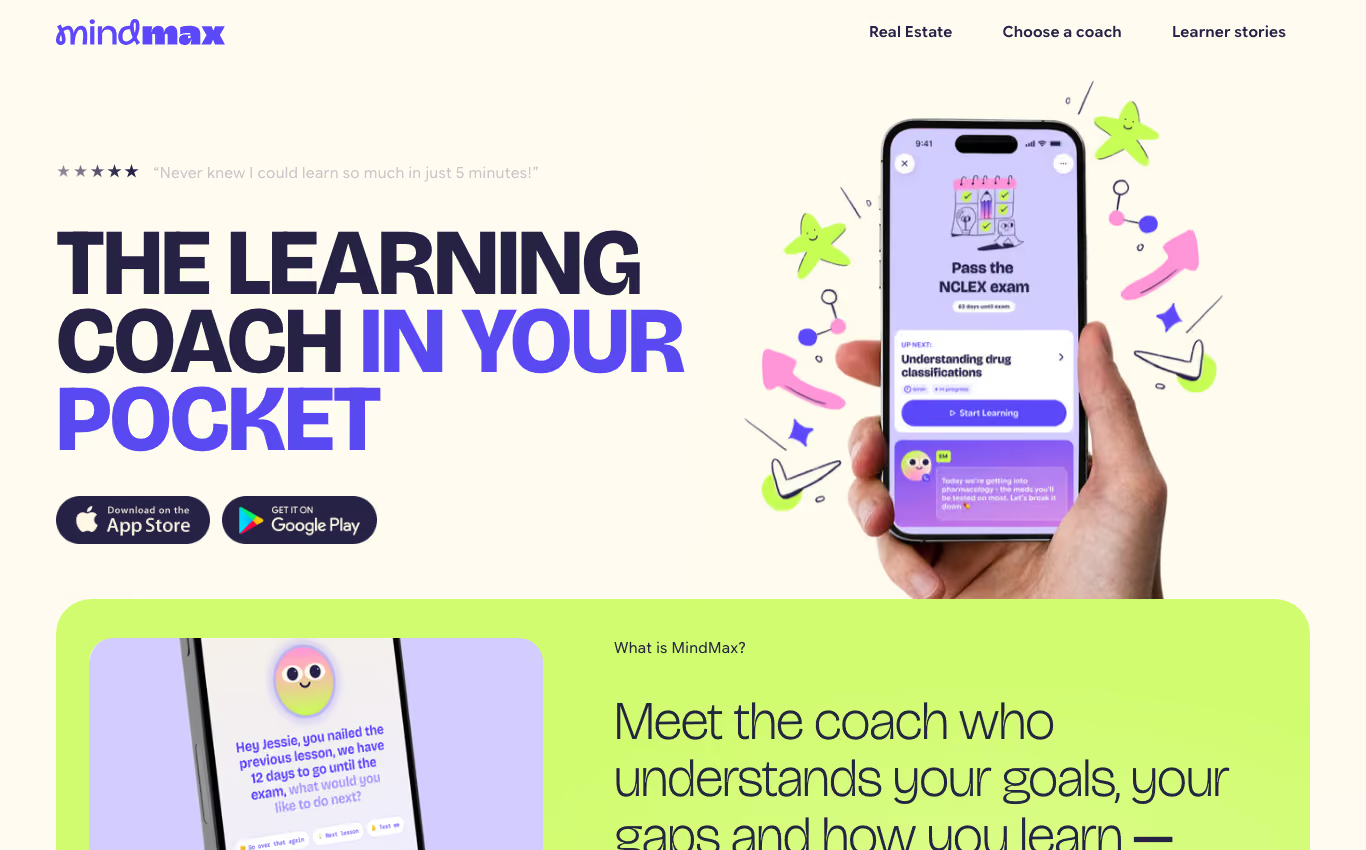
Mindmax is a voice AI tutor for people who need to pass professional exams. It raised $3.3M in a pre-seed round and made the news.
A $3.3M pre-seed round, announced in the first week of November. mindmax.it · The Next Web · Tech Funding News
Images: courtesy / Mindmax
Product
- Problem: Professional exams and reskilling are a retention problem: adults study with videos and notes, then forget. The trigger this week was the round, but the question is pedagogical.
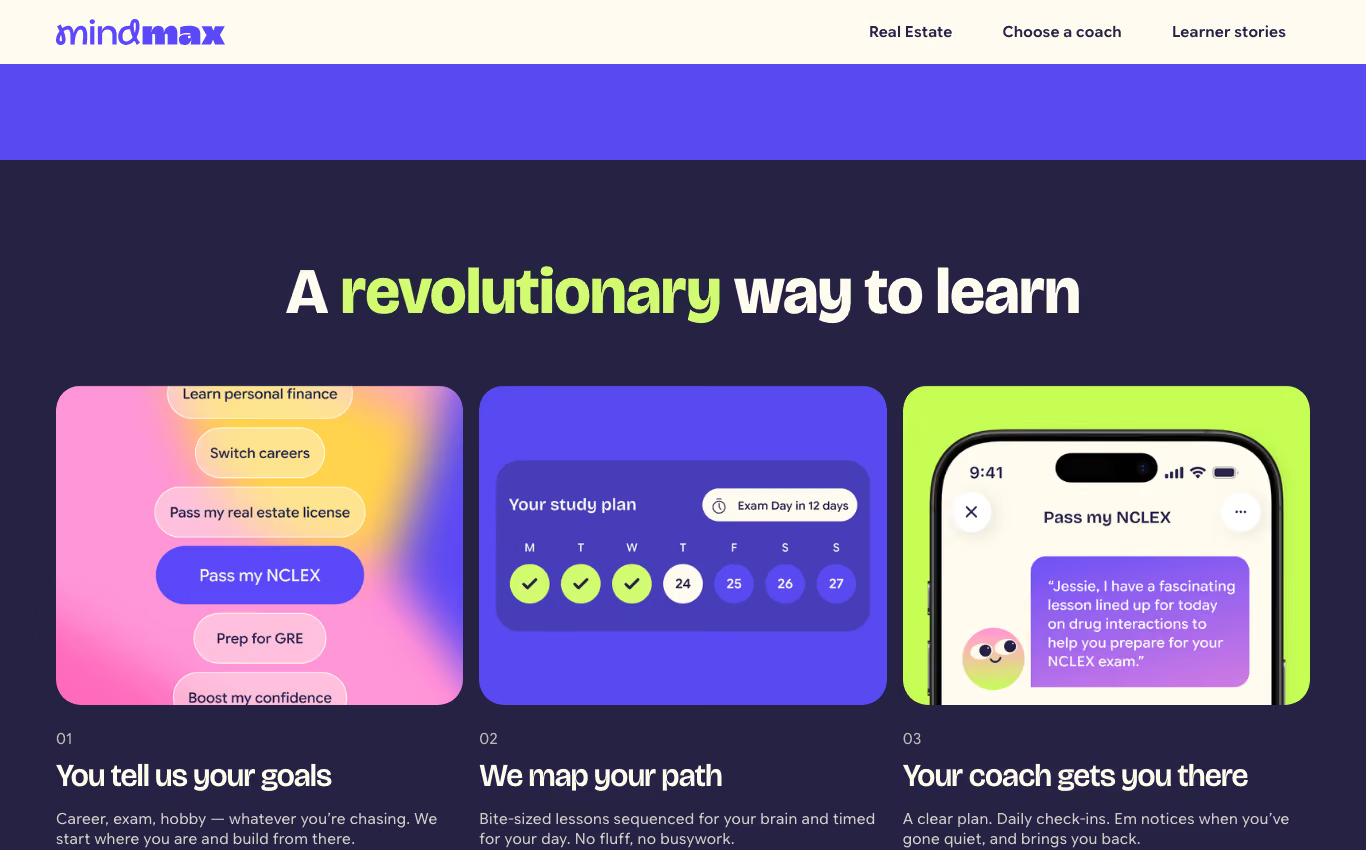
- How it solves it: An AI tutor in real-time conversation. You state the goal (for example, passing a licensing exam), the app builds short lessons and you talk through them with the tutor, which adapts to what you already know and draws diagrams on screen.
- Audience: Adults who need to pass professional exams or learn skills for work, according to the company. The site shows examples such as NCLEX and the real estate license.
- What I found interesting: The thesis against “cognitive surrender”: the product positions itself to make people think more, not less. Being able to interrupt the tutor is what a good private teacher allows and a video does not.
- What I would do differently: I would show the learner explicitly what they still have not mastered and when they will review it. The site talks about finding gaps and making sure you remember, and that is where the product needs to prove its value with retention data. The user accounts I found are individual: one on the App Store reports passing the exam and one on Google Play reports freezes. The 4.9 rating on the site is the company’s own, and I found no independent study or pass rates.
- What we can learn: An interruptible conversation is a better interface for doubt than a video player. Anyone building training should ask how many questions the learner can ask per hour.
Technology
- What we know: the app is already in the iPhone and Android stores, according to Tech Funding News. The company describes real-time lessons adapted to what the user knows, with illustrations generated during the conversation. The team is small: eight people, according to the same source. The app pages on the App Store and Google Play confirm it exists in both stores; the description of adaptive lessons and real-time illustrations is the company’s, and I found no independent validation.
- What I think: the technical challenge is latency and quality control, because a voice tutor that gets an exam fact wrong is expensive. I have not seen the implementation, so I would confirm whether there is in verified exam material before trusting it. Specialist press (eu.vc) points to the same risk, a tutor confidently teaching an error.
- What you can learn from this: real-time voice raises the feeling of tutoring, but it increases cost per session and the risk of unsourced errors. Choose it when the learner’s doubt is the bottleneck, and measure cost per lesson minute.
Business
- Overall take: the founders come from Memrise, which the company says passed 80 million users, and the pre-seed round ($3.3M, or £2.5M) was led by Concept Ventures, with Redrice, Daybreak and Lerer Hippeau. It is money to prove a hypothesis, not to scale. The game is showing that an adult with a deadline (the exam) pays and comes back. The round is reported by specialist press (eu.vc), but from the company’s announcement; the 80 million users at Memrise is also the company’s number, and I found no independent validation.
- Defensibility: still thin. A conversational tutor is copyable. The possible moat is the database of gaps per exam and the founders’ brand in memory retention.
- Metrics I would track: exam pass rate (the only one the learner actually buys), week-4 retention (anticipates whether it becomes a habit) and inference cost per minute (anticipates margin).
My bet is that the niche of exams with a set date is the right path for an AI tutor, because it gives a measurable result. The risk is becoming "just another chat". If they publish pass rates, they win the category. If they stay with testimonials, they stay on the shelf of study apps.
YoLearn.ai Pragya — a national LLM built to teach
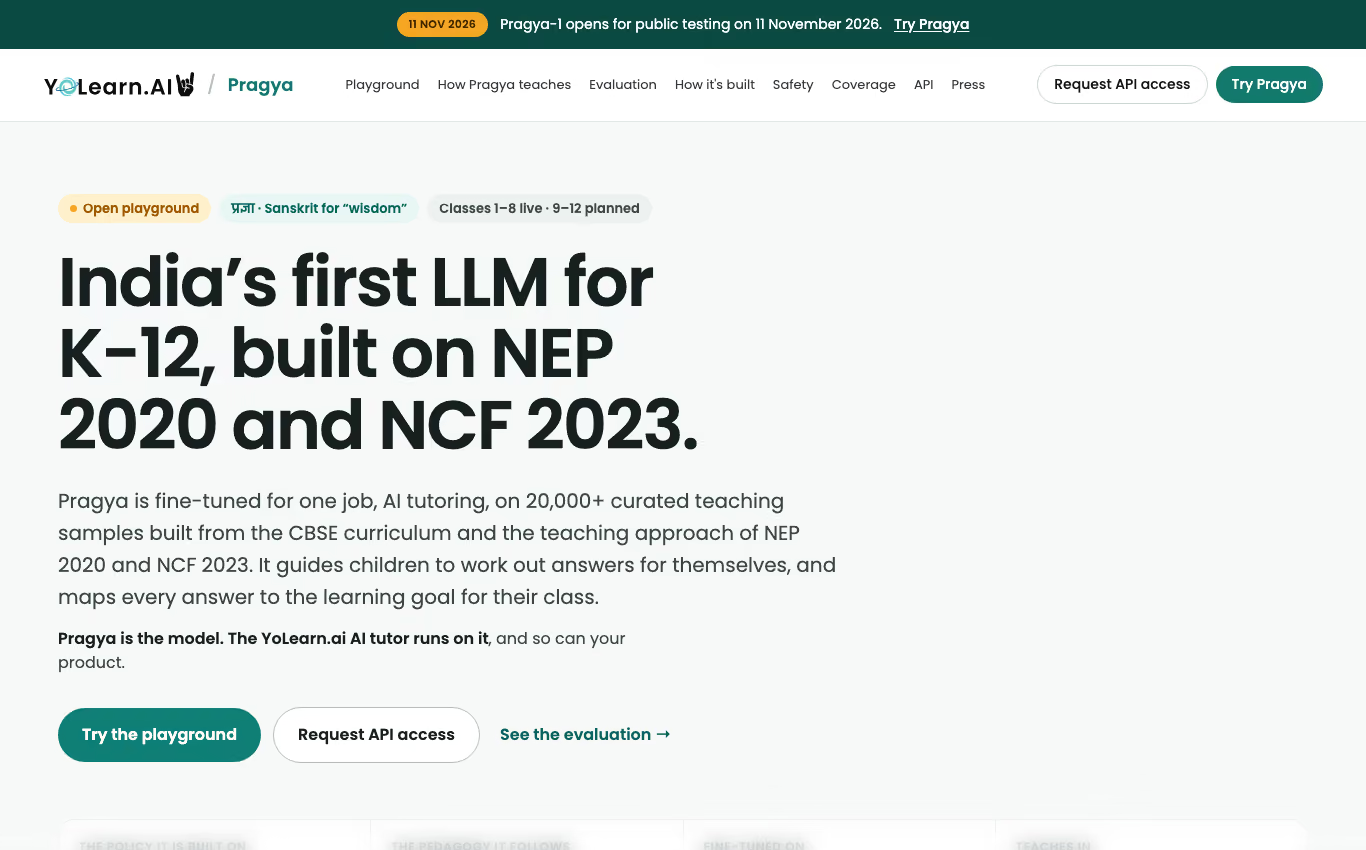
YoLearn.ai is an AI tutoring platform for Indian school education. It launched Pragya, an LLM of its own built to teach the local curriculum.
Launched on November 11. yolearn.ai/pragya · Times of India (sponsored brand content)
Images: courtesy / YoLearn.ai Pragya
Product
- Problem: According to the company, most AI tutors in India run on global models, which tend to hand over the answer and know little about the local curriculum.
- How it solves it: Pragya is a model tuned only for tutoring, trained on CBSE curriculum data, that questions and guides the learner step by step. It works in more than 12 Indian languages and powers the YoLearn.ai tutor.
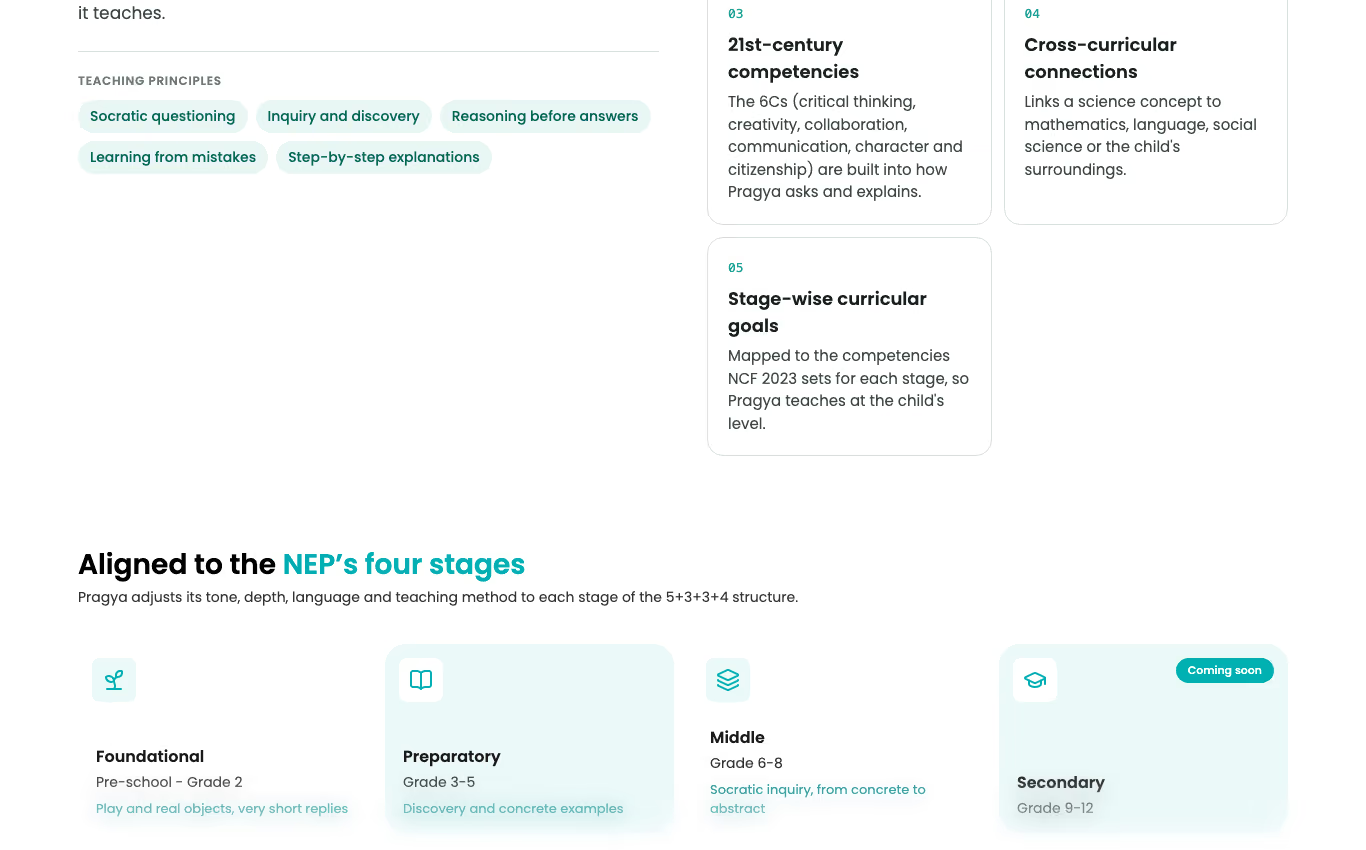
- Audience: School students (classes 1 to 8 live, 9 to 12 planned, according to the site) and publishers, school chains and governments that want to build on the API.
- What I found interesting: Aligning the model with national education policy (NEP 2020 and NCF 2023) and the child’s language. Putting pedagogy in the model, not only in the prompt, is a product choice.
- What I would do differently: I would publish the evaluation so third parties can reproduce it. The company says Pragya scored 85% higher than a general model and was preferred in 92% of cases by 20 teachers, but those numbers are its own and I have not verified them. Those numbers are YoLearn.ai’s own, repeated by Elets and in the sponsored Times of India piece; I found no independent evaluation or reproducible benchmark. KMP-Bench shows leading models still struggle to apply pedagogical principles, which makes the claim testable but does not validate it.
- What we can learn: Local curriculum plus local language is a stronger argument than “better AI”. Anyone building for a country should start from what local policy expects the child to learn.
Technology
- What we know: according to the company, it is an LLM fine-tuned on more than 20,000 curated teaching samples from the CBSE curriculum, evaluated on 5,000 NCERT-aligned questions, trained and hosted in India. There is an open playground and API access. I did not confirm which base model is used. The training data, the evaluation set and the hosting in India are the company’s descriptions; I found no independent validation.
- What I think: fine-tuning for behavior (asking instead of answering) is cheaper and more predictable than training from scratch, and “sovereignty” is as much a technical argument as a sales argument to governments. I have not seen the implementation, so I would confirm how it avoids hallucination on factual content, for example with over the textbooks.
- What you can learn from this: tuning model behavior pays off when the pedagogical tone is the product. The cost is maintaining your own model and proving quality against general models that improve every quarter.
Business
- Overall take: it is a platform move. Instead of only selling an app, the company offers a model and an API to publishers, chains and states, and says it has 20,000 partner schools. The trigger is the launch, but the real game is becoming infrastructure. I found no revenue or funding figures, and I did not confirm them in an official source. The 20,000 partner schools are a company claim, and I found no independent source.
- Defensibility: curated curriculum data and review by Indian teachers are the moat, along with contracts with schools. The model itself can be caught up to by general models.
- Metrics I would track: third-party use of the model via API (shows whether it becomes a platform), learning measured in external assessment (anticipates school renewals) and cost per student.
I bet that the value is in the curriculum and evaluation layer, not in the model. If YoLearn.ai opens its evaluation to scrutiny and wins over publishers, it becomes infrastructure. If the numbers stay in the press release, Pragya will be seen as one more tutor with a nice name.
AiR NOVA — a tutor built on 40 years of journalism
AiR NOVA is a question-and-answer app for students, built by DongA Science from its science journalism archive. It was announced, with launch planned for January 2027.
Announced on November 9, with launch planned for January 2027. nova.dongascience.com · Press release (PR Newswire, via Yahoo Finance)
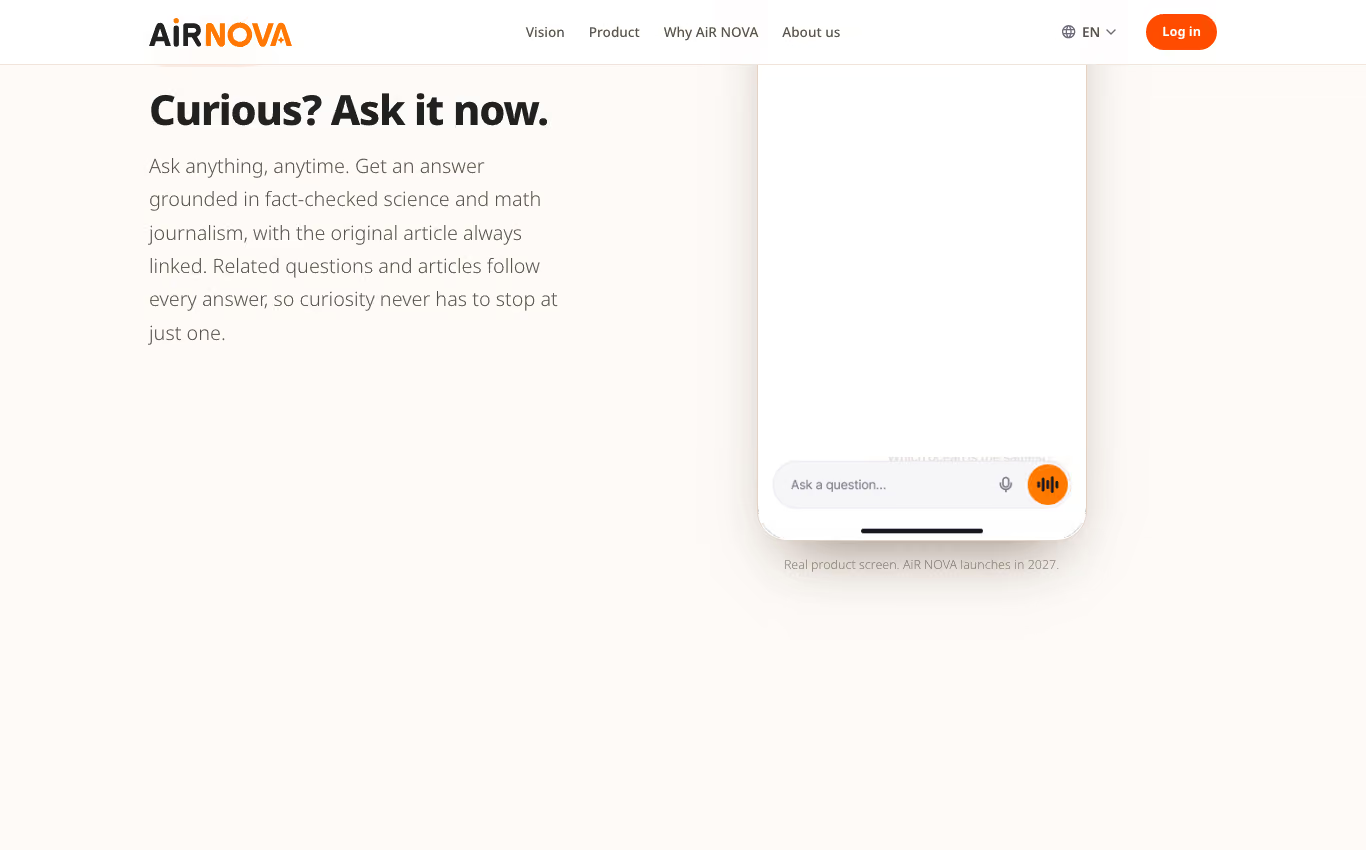
Images: courtesy / AiR NOVA
Product
- Problem: Children ask more questions than parents and teachers can answer, and web search returns unverified results, according to the site.
- How it solves it: A Q&A app for K-12 that answers from the DongA Science archive and shows the source article for each answer. There is also a Socratic mode and an inquiry-missions mode, according to the press release.
- Audience: K-12 students. The launch is in Korean, English, Vietnamese and Spanish, according to the press release.
- What I found interesting: Showing the source of each answer teaches a skill almost no tutor teaches: checking where a claim comes from. Turning a publisher’s archive into an educational product is a creative way out for journalism.
- What I would do differently: The product is not live yet, so I would ask for a parent dashboard of what the child asked. I would also say clearly that the site’s hero image is an illustration of intended use. The only classroom-use account I found is DongA Science’s own, in Korean, on engagement and self-efficacy in a high school class, which I read by headline only; I found no independent evaluation.
- What we can learn: If you have a trusted archive, it can be the product. A verifiable source is worth more than a bigger model.
Technology
- What we know: answers come from more than 100,000 DongA Science articles, and the app shows the source article. In other languages, the learner gets the answer and the translated article. The Socrates mode, which the company says is patent-pending, replies with guiding questions. The archive of over 100,000 articles and the pending patent on the Socrates mode come from the company’s paid press release; I found no independent validation.
- What I think: it is a design over a closed archive, in the spirit of , instead of searching the open web. I have not seen the implementation, so I would confirm how they handle questions outside the archive and the translation quality.
- What you can learn from this: restricting the source reduces hallucination and makes the answer auditable, at the cost of coverage. Choose it when trust matters more than breadth.
Business
- Overall take: the trigger is the CES 2027 honoree recognition (EdTech category), according to the company, but what matters is the logic: a publisher with a 40-year archive turns content into a learning subscription, at a time when publishers debate how AI uses their text. I found no price or billing model, and I did not confirm them in an official source. The honoree listing is on the CES site, but it is a product award, not a learning study.
- Defensibility: the own, verified archive is the moat, and it is hard to copy. The weakness is scale: a Korean science archive has to cover children’s questions in four languages.
- Metrics I would track: questions per student per week (anticipates habit), rate of questions the archive cannot answer (shows the limits of the design) and trial-to-subscription conversion.
I bet that the archive is the product and that the 3 in Business reflects the timing: without a launch, everything is a promise. If they debut in January with good coverage in four languages, they become a reference for publishers who want to enter AI without giving away their content.
OpenEvidence Learn — the clinician’s tool becomes a school
OpenEvidence is an evidence lookup tool used by physicians. It launched Learn, a free medical education platform.
Launch announced on November 4. openevidence.com · Unite.AI (AI-generated article reviewed by the newsroom)
Product
- Problem: People in medical training study on platforms separate from the tool they use to look up evidence, and continuing learning ends up scattered.
- How it solves it: A free platform with four tools: a question bank (more than 50,000 board-style questions), Socratic case-based tutoring (Preceptor), spaced-repetition flashcards and continuing-education credit for questions the clinician already asks. The four tools and the 50,000+ questions come from the company announcement, repeated by an AI-generated article; I found no independent validation of Learn.
- Audience: Medical students, residents and clinicians throughout their careers.
- What I found interesting: The design starts from an existing habit: credit for questions already being asked ties learning to work, as Scholé did in issue #1 for the corporate world.
- What I would do differently: I would show how Preceptor handles a case where the learner’s own reasoning is wrong, not only the right case. I could not access the product (it requires sign-up), so this reading is from the outside.
- What we can learn: When you already have the professional’s attention, learning can be an extension of use, not a second product.
Technology
- What we know: according to the article, the four tools use the same base of peer-reviewed evidence and guidelines that powers OpenEvidence answers. Johns Hopkins and Penn’s Perelman School of Medicine were named at launch. I did not confirm the details in the company’s official release.
- What I think: reusing the clinical base to generate questions, cases and cards is efficient and keeps everything consistent. I have not seen the implementation, so I would confirm how generated questions are validated by specialists. On the clinical tool behind that base there are independent studies with favorable results (primary care, obstetrics and gynecology) and also limits: 34% accuracy on subspecialty scenarios in a pilot not yet peer reviewed, and generalist models ahead in one comparison. Those studies assess the clinical tool, not Learn; for the generated questions and the Preceptor I found no independent validation.
- What you can learn from this: when you already have a trusted knowledge base, generating practice on top of it is cheap. The risk is a content error in an area where it weighs a lot.
Business
- Overall take: it is a funnel extension. A free study product brings the resident into the platform early, and that resident becomes the physician who uses the clinical tool. I did not confirm OpenEvidence’s revenue, valuation or monetization model in an official source.
- Defensibility: the updated evidence base and the partnerships with medical schools. The moat grows if residency programs adopt the tool in their curriculum.
- Metrics I would track: weekly active residents, because they show habit, and the conversion from study use to clinical use, because it is the reason the free product exists.
I bet that medical education is good ground for grounded AI, because there is a source of truth and a user willing to study. The risk is trust: a clinical content error is expensive. If schools adopt it, the product closes the loop between studying and practicing.
Unacademy — the end of one cycle and the start of another
Unacademy is an Indian exam-preparation platform. It changed CEOs two months after being acquired by upGrad.
Leadership change on November 11, two months after the acquisition. unacademy.com · Inc42 · Business Today
Images: courtesy / Unacademy
Product
- Problem: The platform started as a YouTube channel in 2015 and became a unicorn during the pandemic. When in-person classes returned, online demand fell, according to Inc42, and the company went through layoffs and closed verticals.
- How it solves it: The site presents itself as preparation for more than 200 exams, with leading educators. This week the news is not product, it is governance.
- Audience: Candidates for competitive exams in India.
- What I found interesting: The trajectory is a product case study: growing on a format (video and star educators) that may depend on a market moment.
- What I would do differently: I would ask which part of the experience is really different from a video catalog and what the integration with upGrad changes for the learner. I do not have data to answer.
- What we can learn: Scale without retention and without margin is not a moat. Anyone building education should plan the business life cycle from the start.
Technology
- What we know: there is no technical announcement this week. The site cites 10 crore learners and more than 200 exams, the company’s own numbers, which I have not verified.
- What I think: I have no basis to talk about Unacademy’s technical stack, so I prefer not to speculate. That is why the Technology score here is neutral.
- What you can learn from this: in video content platforms, technology is rarely the differentiator. The catalog and distribution decide. It makes sense unless your differentiator is truly technical.
Business
- Overall take: according to Inc42 and other outlets, upGrad completed the purchase in September 2026 for just over $200M, a drop of about 94% from the peak of roughly $3.4B in 2021 (figures reported by the press, not confirmed in an official source). On November 11, Gaurav Munjal moved from CEO to executive chairman and Akhilendra Kumar took over as CEO. Munjal says he will stay involved and help with upGrad’s IPO. With this, all cofounders have left operations, according to Inc42. The sale at about $206M, 94% below peak, has independent sourcing: TechCrunch and The PIE News. The CEO’s claim that the company was profitable or close to it, with about INR 900 crore in cash, is his own, reported by the press and unaudited. I found no independent study of learning outcomes.
- Defensibility: the brand and the user base remain assets. The real moat, retention in exam preparation, I could not confirm.
- Metrics I would track: revenue per active learner and subscription renewal rate, because they say whether the acquired base turns into revenue; and margin per course, because the company has already cut verticals.
I bet that this case is more a lesson in cycles than in product: a pandemic-era valuation does not hold without retention. The new leadership will have to prove the learner base pays off under upGrad. That is the point to watch next quarter.
The pattern that started to appear
Four of the five builders in this issue sell, in different ways, an AI tutor. The uncomfortable question from issue #1 is back: does AI help people learn or only finish faster? This time the answers come as three design choices.
The first is a trusted source: AiR NOVA and OpenEvidence anchor the tutor in an archive the company controls. The second is pedagogy inside the model: Pragya tries to teach Socratic behavior in the model tuning itself, instead of relying on a prompt. The third is conversation as the interface: Mindmax bets that being able to interrupt the tutor is what changes tutoring.
Unacademy reminds us of the other side: a platform without retention and without margin does not hold, however many people it attracts. The technical pattern, for builders, is where error is expensive (medicine, science) and behavior tuning where the pedagogical tone is the product.
There is also a reading warning: two of this week’s five triggers came from paid press releases or the brand’s own sponsored content, and a third from an AI-generated article. In edtech, the performance numbers that arrive first tend to be the company’s own.
This is issue #2. Every week I select, analyze and record, and this base will tell a story about where education is going that no single headline can tell.